
In the previous chapter we analyzed the process of atherosclerosis and its acceleration when the level of plasma triglycerides is elevated. Up to now, the level of triglycerides has been measured during fasting or during normal meal intake.
The instructions for measuring triglyceride levels have so far been as follows:
• For the fasting measurement, samples were collected after 12-14 hours of fasting.
• Sampling during the period of normal meal intake was to be performed at any time without preparation or announcement.
Morning samples do not show pathological postprandial triglyceride levels due to the long period of non-eating.
The level of triglycerides during fasting may vary depending on:
- the size of meals
- fat content
- timing (first, second meal)
- carbohydrate content
- time elapsed since the meal
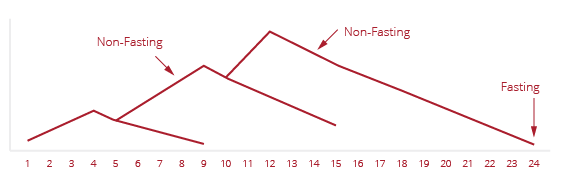
During the day we eat 3-4 meals, each with 20-40 grams of fat. As a result, the cumulative levels of triglycerides are higher than the fasting triglycerides.
Furthermore, cumulative and elevated triglyceride levels are observed after the second, third or fourth meal because the elevated triglyceride levels build on the already elevated levels from the previous meals.
Thus, elevated triglyceride levels appear throughout the day, which cannot be determined from the morning sample.
As a result, determining postprandial triglyceride levels is very important.
Determining triglyceride levels in this way is supported by clinical studies:
- The Women’s Health Study [1]
- The Copenhagen City Heart Study [2]
- The Physicians Health Study [3]
- The Apolipoprotein-related Mortality Risk Study [4]
- The Second Northwick Park Heart Study [5]
- The Norwegian Study [6]
- The EARS II study [7]
- the ARIC study [8]
1. Mora S, Rifai N, Buring JE, Ridker PM. Fasting compared with non-fasting lipids and apolipoproteins for predicting incident cardiovascular events. Circulation 2008; 118: 993-1001.
2. Nordestgaard BG, Benn M, Schnohr P, Tybjaerg-Hansen A. Non-fasting triglycerides and risk of myocardial infarction, ischemic heart disease, and death in men and women. JAMA 2007; 298: 299-308.3. Stampfer MJ, Krauss RM, Ma J, et al. A prospective study of triglyceride level, low-density lipoprotein particle diameter, and risk of myocardial infarction. JAMA 1996; 276: 882-8.4. Talmud PJ, Hawe E, Miller GJ, Humphries SE. Non fasting apolipoprotein B and triglyceride levels as a useful predictor of coronary heart disease risk in middle-aged UK men. Arterioscler Thromb Vasc Biol 2002; 22: 1918-23.5. Waterworth DM, Talmud PJ, Bujac SR, Fisher RM, Miller GJ, Humphries SE. Contribution of apolipoprotein C-III gene variants to determination of triglyceride levels and interaction with smoking in middle-aged men. Arterioscler Thromb Vasc Biol 2000; 20:2663-9.6. Stensvold I, Tverdal A, Urdal P, Graff-Iversen S. Non-fasting serum triglyceride concentration and mortality from coronary heart disease and any cause in middle aged Norwegian women. BMJ 1993; 307: 1318-22.7. Tiret L, Gerdes C, Murphy MJ, Dallongeville J, Nicaud V, O’Reilly DS, Beisiegel U, De Backer G. Postprandial response to a fat tolerance test in young adults with a paternal history of premature coronary heart disease – the EARS II study (European Atherosclerosis Research Study). Eur J Clin Invest. 2000 Jul;30(7):578-858. Sharrett AR, Chambless LE, Heiss G, Paton CC, Patsch W. Association of postprandial triglyceride and retinyl palmitate responses with asymptomatic carotid artery atherosclerosis in middle-aged men and women. The Atherosclerosis Risk in Communities (ARIC) Study. Arterioscler Thromb Vasc Biol. 1995 Dec;15(12):2122-9.
Determination of postprandial triglyceride levels after consuming Lipidtest meal is done using a lipid profile.
It is worth mentioning that in 1979 Zilversmit was the first person to link the development of atherosclerosis with processes occurring after a meal and emphasized the need for postprandial examinations.
Many clinical studies have confirmed the importance of postprandial triglyceride testing and have shown that elevated levels are observed in patients with:
- heart disease
- hypertension
- type 2 diabetes
- obesity (BMI) > 27 kg/m2
- metabolic syndrome
- elderly people
- menopausal women
- smokers (even with normal triglyceride levels)